Only a few days ago, Senator Joe Manchin announced his Christmas present for the working families of America. Was it Christmas themed? Arguably, since Dr. Seuss’s story, “How the Grinch Stole Christmas” is a holiday classic. Like the Grinch, he is rounding up the good things that the people want and are entitled to.
Expanded Earned Income Tax Credit and Child Tax Credit, lifting many families out of poverty? Taken away.
Reduced premiums for health insurance? Taken away.
Stronger negotiations for medications needed by ordinary Americans? Taken away.
Universal Pre-K? Taken away.
Expanded childcare, allowing millions to have someone to care for their kids while they participate in the labor force? Taken away.
Expanded home health care service for medicaid enrollees? Taken away.
Paid family and medical leave? Taken away.
Investments in expanded housing at lower prices for renters and homeowners? Taken away.
Unfortunately, this is not a children’s story and all signs indicate that Senator Manchin’s heart isn’t going to grow 3 sizes and give the people of the United States what they need and deserve.
Students shouldn’t have to borrow to get a college education. Decades ago, free college education was provided by many governments in the United States and free college remains the norm in several European countries, all of which are less rich than the United States. For decades, the cost of a college education has gradually been shifted from the government to working class parents and students. Between 1980 and 2018, the cost of tuition rose about twice as fast as the median household income.
During the 2020 presidential campaign, Joe Biden promised to eliminate at least $10 thousand of federal student loan debt for each borrower. Since then, Senator Elizabeth Warren has been joined by the moderate Senate Majority Leader Chuck Schumer in calling for cancelling $50 thousand in federal student loan debt. Many have pointed out that cancelling repayment of federal student loan debt can occur without enacting a new law, simply through an executive action.
According to the Roosevelt Institute, cancelling $50 thousand in federal student loans would increase black wealth by 40%. In addition, it would help many others, mostly of lower to moderate incomes, who are financially underwater because of student loans. Without having to worry about such a large debt, they will be able to focus their resources on building a better, more secure future for themselves and their children.
This can and should be the first step to make college free for this generation and those that follow.
Poverty has been a perennial problem for Guam. Between the 2000 and the 2010 Guam Censuses, Guam’s individual poverty rate declined slightly form 23% to 22.9%, which is statistically negligible. There is no equally authoritative figures on poverty since that point, but we could examine the enrollment rates in the means-tested Supplemental Nutrition Assistance Program (SNAP) as a proxy, which indicates that between fiscal years 2009 and 2019 the number of individuals enrolled in SNAP rose from 31,511 (19%) to 40,930 (24%), with the numbers in parentheses representing enrollment as a percent of the estimated population according to the U.S. Census International Database. My concern, however, is not with cataloguing poverty on Guam, but developing a serious approach to poverty reduction or elimination.
A commonsense approach that I will take is to look at the income characteristics of the working poor and see what might be done to ensure that an overwhelming majority of working people would no longer be in poverty. I would take as a guide “A profile of the working poor, 2018” by the U.S. Bureau of Labor Statistics. While this may not reflect all of the conditions in Guam, I believe the broad outlines of what should be done in a serious approach to poverty is addressed by the information in the report, regardless of jurisdiction.
Unsurprisingly, persistently unemployed workers are most likely to be in poverty (38.7%), followed by involuntary part-time workers (19.9%, being those who would want to be full time workers but can only find part-time employment), followed by voluntary part-time workers (10.2%), and finally full time workers (3.3%). From this, it is easy to extrapolate that providing employment opportunities to the unemployed or underemployed would reduce poverty.
According to the report, workers had different experience with unemployment based upon whether they experienced one or more labor market problem. The poverty rate is lowest among workers with none of the identified labor market problem and is higher for workers who had one of the identified labor market problems, highest for workers who had more than one of the identified labor market problems, and highest among those who had each of them. For ease of presentation, consider the following chart of labor market problems:
As one can see from the chart above, the combination of any of the labor market problems results in a higher poverty incidence than either factor would indicate, by itself. Low earnings, which is defined as earnings of less than $369.59 per week (for 2018), is the one strongest factor in determining one’s poverty status. This cannot completely be divorced from unemployment or having less than desired employment since one can think of earnings as a combination of hours worked multiplied by the hourly wage.
As noted earlier, reducing or eliminating involuntary unemployment would reduce the poverty rate. However, depending on the wage that is offered, that may result in a relatively minor reduction in the poverty rate. In Guam, the current minimum wage is $8.75 per hour. If a worker makes minimum wage for 40 hours a week, they would earn $350 per week, which is still less than the 2018 benchmark for low earnings. If one were to apply an inflation rate of 2%, the benchmark would update to $384.52 per week in 2020. For an individual to earn that much per week in a 40 hour schedule, the hourly wage would have to be $9.62 per hour (as an aside, Guam’s minimum wage will rise to $9.25 by March 2021).
As noted parenthetically above, the minimum wage is getting considerably closer to ensuring that low earnings for full time employment could be a thing of the past (although the minimum wage will have to be updated from time to time to ensure it is able to match the rise in the cost of living).
Another contributor to poverty is the size of a family. In particular, families with related children under 18 have a higher rate of poverty than those without related children under 18. This can be explained by the fact that poverty varies statistically based upon family size. But it should be remembered that while this is a convention, it is based upon the fact that to have an equivalent living standard for a larger family, one must have more resources. In addition, married couple families have the lowest poverty rate followed by families maintained by men, and lastly by families maintained by women. The difference between married couples and families may be partly explained by the higher likelihood that there are multiple earners per family, but that is not necessarily the end of the story. As for the discrepancy between households headed by men or women, it is well known that women generally earn less than men, not only on average, but also adjusting for other relevant factors.
It seems clear that if families with children are more likely to be in poverty than families without children, then a serious approach to poverty would seek to ensure that families with children should have more resources. In addition, this differential may also arise because of some of the special challenges workers with children face, like having quality day care available, being able to ensure that their children are taken to and from school, etc.
It may be more controversial, but the well-documented disparities between men and women almost certainly play a role, as one can see by the differential between women-maintained households and men-maintained households which is present both for families with and without children. Two kinds of measures can move in the direction of ensuring more equitable pay for women. First and less directly, one may make it illegal for employers to take adverse actions against employees for discussing their compensation with other employees. Second and more directly, one could strengthen prohibitions against discriminatory compensation or providing for more systematized pay structures in companies by adopting uniform pay schedules. Taking action on both kinds of measures would likely be the most effective approach to seriously addressing pay disparities and ensuring that fewer women-maintained households would find themselves in poverty. I would note that these measures would also address disparities between races. Although there are racial disparities on Guam, the racial categories covered in the report are less relevant, as there are few Hispanic or African Americans on Guam.
This discussion has largely been to provide the broad measures that would be taken in a serious approach to poverty. I would expect that some would criticize this presentation for not discussing the need for education opportunities for those who have lower incomes. Of course this is important, as are other issues. However, I do not subscribe to the idea that one must have a “passport” to “exit” poverty. I believe we should not have poverty for those who are willing and able to work, whatever their age or level of education, and for those who are unable to work through no fault of their own (elderly, disabled, etc.).
I would summarize the policy approaches outlined earlier with regard to establishing a serious approach to policy as follows:
(1) providing employment opportunities to the unemployed or underemployed, such as a Universal Job Guarantee and/or specialized employment programs;
(2) adopting a minimum wage of at least $9.62;
(3) providing additional resources to families with children, whether in cash or by extending additional services such as child day care;
(4) prohibiting employers from taking adverse actions against workers for discussing their compensation with coworkers; and
(5) strengthening prohibitions against discriminatory compensation; and
(6) requiring employers to adopt uniform pay schedules.
There are a number of stories about the minimum wage, both by proponents and by opponents to it. Some are known to be true or false empirically or a priori (although those are usually based on the most extreme caricatures of a position, like the $1,000 per hour minimum wage), naturally some are not known but there is a fair amount of evidence and/or reasoning to suggest the direction in which one ought to lean, and there are no doubt some about which it is well justified to take an agnostic position (where one doesn’t know and doesn’t have a level of confidence to feel comfortable coming to a tentative conclusion). Among the most persistent myths is the idea that moderate increases in the minimum wage would result in unemployment.
I have recently come across this myth in a particular form that I would like to address, as it seems to be gaining in acceptance as a talking point. I say talking point for a particular reason: it seems to have turned into a bit of a slogan by the less scrupulous, less savvy commentators on the political right. The way I have seen it phrased is, “The real minimum wage is $0.” Before I get into why I believe this is wrong, I will sum up a very limited set of circumstances where it is right. First, there are genuinely education internships which where one is allowed to and willing to work for $0 per hour (as to whether these should be allowed, that is a separate issue). Second, there are formal volunteer activities which people engage in at no cost to an employer (activities for churches, for charities, for certain community projects). Third, people choose to engage in productive activity for themselves, their friends, and their family all the time and, naturally, no one expects to be paid for that (housework, childcare, etc.). These exceptions, however, are absolutely not what “the real minimum wage is $0” is intended to mean. Instead, the claim is more in line with the idea that the minimum wage causes unemployment.
As Mr. David Sukoff (pronounce his last name carefully) said in his brief article earlier this year, “At any level above zero, a minimum wage has the potential to exclude someone from employment. At any level above zero, then, there exists the possibility of harm to people. At zero, that possibility simply does not exist.” This is an argument that has some level of prior plausibility. After all, it is quite intuitive to state a priori that if we limit peoples’ ability to engage in contracts based on a given wage threshold, that less contracts will be entered into. However, the reason we engage in the process of empirical falsification is precisely to find where our a priori reasoning leads us in the wrong direction. It is dishonest to assert as fact what one does not know to be true. In the absence of empirical evidence, the best we could say is that our reasoning suggests that any minimum wage over $0 will result in unemployment. If we had empirical evidence which led us in the same direction, at a certain point it would be justified to say that one knows this to be the case. However, the data we have does not support that conclusion.
As I mentioned in “On Guam’s minimum wage,”Center for Economic and Policy Research (2013) has found that the best research indicates no statistical relationship between the level of the minimum wage and unemployment. This fact is more supportive of the hypothesis that there is a pareto efficient minimum wage above $0. The market-clearing level of wages for low income workers is clearly more than $0. In fact, it the data we have is suggestive that perhaps a surprising range of values for the minimum wage are consistent with the level of employment which prevails. If a market wage of $7.25 results in a given rate of unemployment and an increase of the minimum wage were to occur within the range of our empirical experience, then it would be reasonable to expect from the data we have that no statistically significant increase in the rate of unemployment will occur, leaving workers better off to the extent of the increase in the minimum wage less any increase in the cost of living which coincides. From the Center for Economic Policy Research’s study, a 10% increase in the minimum wage is associated with an increase of approximately 0.4-0.7%. in overall prices. Thus, raising the minimum wage within the range of our empirical experience can be expected to provide a net benefit to workers at or near the minimum wage.
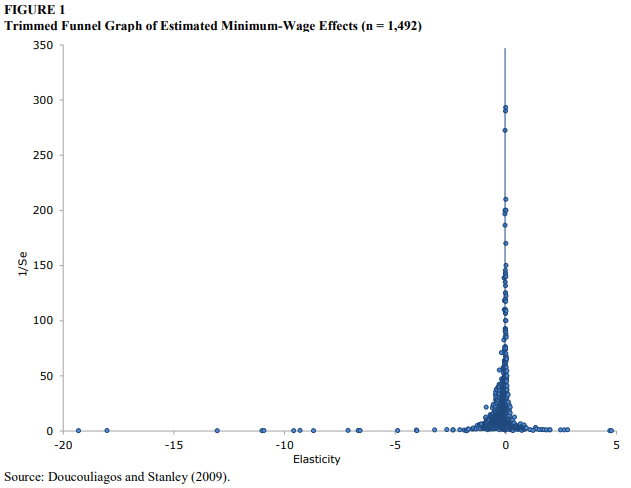
To illustrate the strength of the evidence against the contention that minimum wage causes employment, observe the funnel graph above, represented in the Center for Economic and Policy Research study and derived from the work of Hristos Doucouliagos and T. D. Stanley (2009). Doucouliagos and Stanley’s meta analysis, which aggregated 1,495 studies on the effect of minimum wages on teenage employment, which would disproportionately reflect the low-skilled workers most likely to be affected by any potential unemployment effect, found that “minimum wages may simply have no effect on employment” or that “minimum-wage effects might exist, but they may be too difficult to detect and/or are very small.” This hardly gives good support for the $0 minimum wage myth.
The fact that the empirical evidence goes against “The real minimum wage is $0” hypothesis should make any reasonable observer come to one of two possible conclusions about the commentators who have propagated that myth. The first is that they could be uninformed about the empirical case against their position. The second is that they do not care what the empirical evidence appears to indicate. Frankly, both of these are troubling possibilities. If one is choosing to comment on a policy question and yet unwilling or unable to do the research to see that their position is not supported by the evidence, then that reflects very poorly on the individual because it implies they are dogmatic or incompetent. If, on the other hand, one is commenting on a policy question and yet is unwilling to downgrade their level of confidence in their conclusion, that suggests that the individual has a very dim view of the empirical evidence. It is especially troubling that, for whatever reason such commentators do not side with the empirical evidence, such commentators very often do not even discuss the empirical evidence and their reason why such evidence should not be seen as persuasive.
It should be quite clear from what I have said above that I am an empiricist. That does not mean that I disregard a priori reasoning, altogether, but rather that I take the position that the proof of the pudding is in the eating. When there is not empirical evidence, I would at least lean in the direction of the best explanation that is available, given the broader context of knowledge. However, when the empirical evidence turns definitively against an explanation that seemed plausible on a priori grounds, then I will side with the evidence. This is precisely what is the case for “The real minimum wage is $0” hypothesis. It sounds initially plausible, but, upon examination of the evidence, it is untenable. We can and do know to a great degree of certainty that the real minimum wage is greater than $0, regardless of any proclamations to the contrary.
Guam law establishes minimum wage and maximum hour standards in the “Minimum Wage and Hour Act of Guam”. Within the law, it defines the purpose of the policy, as follows:
It is declared to be the policy of this Chapter:
(a) to establish minimum wage and maximum hour standards at levels consistent with the public health, efficiency and general well-being of workers;
(b) to safeguard existing minimum wage and maximum hour standards which are adequate to the health, efficiency and general well-being of workers from the effects of the serious and unfair competition resulting from wage and hour standards detrimental to the health, efficiency and general well-being of workers; and
(c) to increase employment opportunities.
Recently, the Guam Legislature passed and the Governor of Guam signed into law an increase in the minimum wage from $8.25 per hour to $9.25 in two increments, with the latter taking effect March 1, 2021. I would argue that this increase in the minimum wage is consistent with the declared policy of the government of Guam, established in the”Wage and Hour Act of Guam.”
Public health, efficiency, general well-being
The effects of a wage level on public health, efficiency, and general well-being are invoked for both subsections of the general policy statement of the “Minimum Wage and Hour Act of Guam.” In evaluating whether the recent increase in the minimum wage is consistent with the intent of the general policy statement, let us take public health and general well-being together, then subsequently address the question of efficiency.
A major consideration in whether a wage level is consistent with public health and general well-being of a worker is whether the wage enables a worker and his or her family to live above the poverty line. According to the U.S. Bureau of Labor Statistics in “A profile of the working poor, 2017,” about 2.7% of U.S. full-time wage and salary workers who were in the labor force at least 27 weeks in the year lived in poverty. The chief labor market problem associated with the poverty status among these workers was low earnings, defined as wages of under $360.78 in earnings per week (which works out to about $9.02 for a 40 hour workweek). Unfortunately, the report does not detail similar information for part-time wage and salary workers. The report lists three major labor market problems: unemployment, involuntary part-time unemployment, and low earnings. 24.9% of full time workers who had low earnings were below the poverty level, but only 12.6% and 10.4% of full time workers who experienced unemployment or involuntary part-time unemployment, respectively, were below the poverty level. These facts would seem to indicate that higher wage levels would result in fewer individuals in poverty, all else equal.
Unlike under regimes with long-term fixed price levels, the people of Guam face consistent, long-term price inflation for goods and services. As such, the levels of wages consistent with public health and general well-being of workers rise over time. Thus, to maintain a minimum wage level that is consistent with previous standards, it would need to be updated on a fairly regular basis.
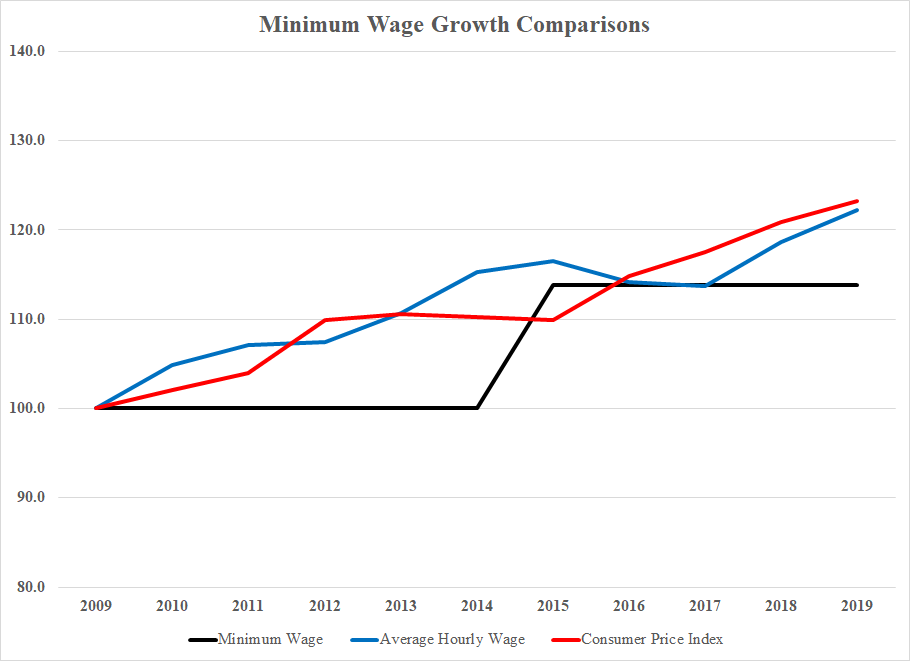
An additional consideration in whether a wage level is consistent with the public health and general well-being of a worker is the question of whether the wage level is at least as favorable to maintaining the living standards of the worker as wage levels in previous periods. If a minimum wage standard degrades in real terms from prior times, it is, almost by definition, less adequate than it previously had been. This can be evaluated by comparison to a measure of the cost of living, like the consumer price index (CPI). Consider the graph below, which shows a comparison between the minimum wage, CPI, and the average hourly wage from first quarter of 2009, when the minimum wage was raised to $7.25 per hour, to the first quarter of 2019, when the minimum wage remained at $8.25. Keeping pace with the increase in the CPI, the minimum wage would have reached about $8.95 in first quarter 2019 to maintain parity with the cost of living.
The comparison to the average hourly wage is presented here to bring in an evaluation of the efficiency of the minimum wage. In maintaining the efficiency of the minimum wage to its earlier standard, linking it to the earnings of the middle-wage worker would preserve parity between the returns to productivity accruing in the market to middle-wage workers to low-wage workers.
Absent evidence to the contrary, it is reasonable to expect that productivity rises similarly for low-wage workers as for middle-wage workers (presuming that the current cohorts remain comparable to prior cohorts, while the individuals will generally move from one cohort to another over time). A reasonable statistical stand-in for the middle-wage cohort would be the average hourly wage of production workers.
Keeping pace with the rising average hourly wage of production workers, the minimum wage would have been $8.85 in the first quarter of 2019.
As mentioned above, all else equal, raising the minimum wage to $9.25 per hour would be expected to lift some portion of low-wage workers out of poverty. In addition, the minimum wage increase more or less keeps pace with inflation, maintaining the purchasing power of the minimum wage compared to the previous standard of $7.25 per hour in 2009, and maintains overall competitiveness compared to the average hourly wage increases over the same period.
Increasing Employment Opportunities
One possible objection to the statement above would be that economic efficiency would be served by reducing the purchasing power of the minimum wage because it would increase employment opportunities among low-wage workers. Despite statements to this effect by some more conservative commentators, it is not well-supported by economic evidence, either in the United States or in Guam.
The contention by such commentators could be that if hourly wages are raised by raising the minimum wage, then higher unemployment rates and/or lower hours would be offered to low wage workers. This sounds plausible and worthy of serious examination. However, as documented in the Center for Economic and Policy Research’s “Why Does the Minimum Wage Have No Discernible Effect on Employment?”, the best research indicates that there is no statistical relationship between the level of the minimum wage and employment. Summing up the result of a meta analysis of the empirical data, Doucouliagos and Stanley are quoted thus, “Two scenarios are consistent with this empirical research record. First, minimum wages may simply have no effect on employment… Second, minimum-wage effects might exist, but they may be too difficult to detect and/or are very small.” That being the case, a moderate increase in the minimum wage (of a few dollars) would likely have a negligible effect on employment, thus providing real benefits to low wage workers.
In addition to the aforementioned research into the effect of minimum wages on employment in the United States, the government of Guam has relatively recently looked into the matter, itself. In January 2015, Guam’s minimum wage was raised from $7.25 to $8.25. In connection with that minimum wage increase, the Guam Department of Labor commissioned a study by Market Research and Development which was released in February 2017. The study found, ” no impact of the hourly minimum wage increase to $8.25 from indicators of Guam’s economy.” That result was based upon examination of the empirical data available. A Guam Business Survey was also included which states that only 11% of the businesses responding have reduced the number of employees. In fact, from December 2014 (just before the minimum increase) to December 2016 (the approximate time of the survey), the Current Employment Report data indicates that payroll employment increased by 1,320 or roughly 2.8%.
Given the background of empirical findings across the United States and the lack of evidence to the contrary for Guam, it is reasonable to conclude that modest increases in the minimum wage, such as the $1 which has recently been enacted, will have little to no adverse economic impact and will therefore result in an overall improvement of the standard of living to low-wage workers. This results in an overall minimum wage that is consistent with the stated policy of the “Minimum Wage and Hour Act of Guam.”
 Janssen Economics