There are a number of stories about the minimum wage, both by proponents and by opponents to it. Some are known to be true or false empirically or a priori (although those are usually based on the most extreme caricatures of a position, like the $1,000 per hour minimum wage), naturally some are not known but there is a fair amount of evidence and/or reasoning to suggest the direction in which one ought to lean, and there are no doubt some about which it is well justified to take an agnostic position (where one doesn’t know and doesn’t have a level of confidence to feel comfortable coming to a tentative conclusion). Among the most persistent myths is the idea that moderate increases in the minimum wage would result in unemployment.
I have recently come across this myth in a particular form that I would like to address, as it seems to be gaining in acceptance as a talking point. I say talking point for a particular reason: it seems to have turned into a bit of a slogan by the less scrupulous, less savvy commentators on the political right. The way I have seen it phrased is, “The real minimum wage is $0.” Before I get into why I believe this is wrong, I will sum up a very limited set of circumstances where it is right. First, there are genuinely education internships which where one is allowed to and willing to work for $0 per hour (as to whether these should be allowed, that is a separate issue). Second, there are formal volunteer activities which people engage in at no cost to an employer (activities for churches, for charities, for certain community projects). Third, people choose to engage in productive activity for themselves, their friends, and their family all the time and, naturally, no one expects to be paid for that (housework, childcare, etc.). These exceptions, however, are absolutely not what “the real minimum wage is $0” is intended to mean. Instead, the claim is more in line with the idea that the minimum wage causes unemployment.
As Mr. David Sukoff (pronounce his last name carefully) said in his brief article earlier this year, “At any level above zero, a minimum wage has the potential to exclude someone from employment. At any level above zero, then, there exists the possibility of harm to people. At zero, that possibility simply does not exist.” This is an argument that has some level of prior plausibility. After all, it is quite intuitive to state a priori that if we limit peoples’ ability to engage in contracts based on a given wage threshold, that less contracts will be entered into. However, the reason we engage in the process of empirical falsification is precisely to find where our a priori reasoning leads us in the wrong direction. It is dishonest to assert as fact what one does not know to be true. In the absence of empirical evidence, the best we could say is that our reasoning suggests that any minimum wage over $0 will result in unemployment. If we had empirical evidence which led us in the same direction, at a certain point it would be justified to say that one knows this to be the case. However, the data we have does not support that conclusion.
As I mentioned in “On Guam’s minimum wage,” Center for Economic and Policy Research (2013) has found that the best research indicates no statistical relationship between the level of the minimum wage and unemployment. This fact is more supportive of the hypothesis that there is a pareto efficient minimum wage above $0. The market-clearing level of wages for low income workers is clearly more than $0. In fact, it the data we have is suggestive that perhaps a surprising range of values for the minimum wage are consistent with the level of employment which prevails. If a market wage of $7.25 results in a given rate of unemployment and an increase of the minimum wage were to occur within the range of our empirical experience, then it would be reasonable to expect from the data we have that no statistically significant increase in the rate of unemployment will occur, leaving workers better off to the extent of the increase in the minimum wage less any increase in the cost of living which coincides. From the Center for Economic Policy Research’s study, a 10% increase in the minimum wage is associated with an increase of approximately 0.4-0.7%. in overall prices. Thus, raising the minimum wage within the range of our empirical experience can be expected to provide a net benefit to workers at or near the minimum wage.
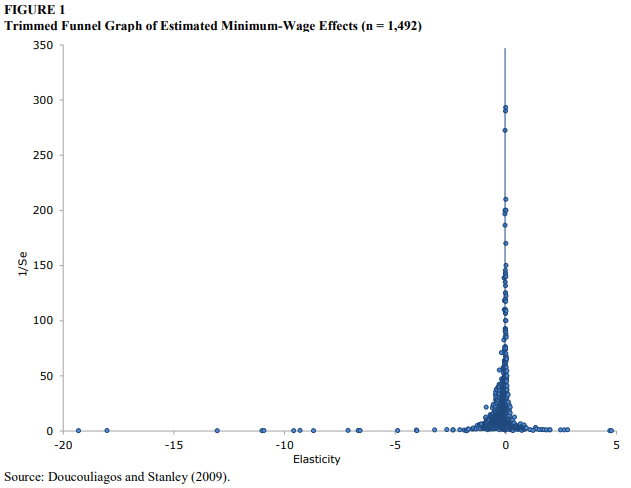
To illustrate the strength of the evidence against the contention that minimum wage causes employment, observe the funnel graph above, represented in the Center for Economic and Policy Research study and derived from the work of Hristos Doucouliagos and T. D. Stanley (2009). Doucouliagos and Stanley’s meta analysis, which aggregated 1,495 studies on the effect of minimum wages on teenage employment, which would disproportionately reflect the low-skilled workers most likely to be affected by any potential unemployment effect, found that “minimum wages may simply have no effect on employment” or that “minimum-wage effects might exist, but they may be too difficult to detect and/or are very small.” This hardly gives good support for the $0 minimum wage myth.
The fact that the empirical evidence goes against “The real minimum wage is $0” hypothesis should make any reasonable observer come to one of two possible conclusions about the commentators who have propagated that myth. The first is that they could be uninformed about the empirical case against their position. The second is that they do not care what the empirical evidence appears to indicate. Frankly, both of these are troubling possibilities. If one is choosing to comment on a policy question and yet unwilling or unable to do the research to see that their position is not supported by the evidence, then that reflects very poorly on the individual because it implies they are dogmatic or incompetent. If, on the other hand, one is commenting on a policy question and yet is unwilling to downgrade their level of confidence in their conclusion, that suggests that the individual has a very dim view of the empirical evidence. It is especially troubling that, for whatever reason such commentators do not side with the empirical evidence, such commentators very often do not even discuss the empirical evidence and their reason why such evidence should not be seen as persuasive.
It should be quite clear from what I have said above that I am an empiricist. That does not mean that I disregard a priori reasoning, altogether, but rather that I take the position that the proof of the pudding is in the eating. When there is not empirical evidence, I would at least lean in the direction of the best explanation that is available, given the broader context of knowledge. However, when the empirical evidence turns definitively against an explanation that seemed plausible on a priori grounds, then I will side with the evidence. This is precisely what is the case for “The real minimum wage is $0” hypothesis. It sounds initially plausible, but, upon examination of the evidence, it is untenable. We can and do know to a great degree of certainty that the real minimum wage is greater than $0, regardless of any proclamations to the contrary.
 Janssen Economics
Leave a comment