Guam law establishes minimum wage and maximum hour standards in the “Minimum Wage and Hour Act of Guam”. Within the law, it defines the purpose of the policy, as follows:
It is declared to be the policy of this Chapter:
(a) to establish minimum wage and maximum hour standards at levels consistent with the public health, efficiency and general well-being of workers;
(b) to safeguard existing minimum wage and maximum hour standards which are adequate to the health, efficiency and general well-being of workers from the effects of the serious and unfair competition resulting from wage and hour standards detrimental to the health, efficiency and general well-being of workers; and
(c) to increase employment opportunities.
Recently, the Guam Legislature passed and the Governor of Guam signed into law an increase in the minimum wage from $8.25 per hour to $9.25 in two increments, with the latter taking effect March 1, 2021. I would argue that this increase in the minimum wage is consistent with the declared policy of the government of Guam, established in the”Wage and Hour Act of Guam.”
Public health, efficiency, general well-being
The effects of a wage level on public health, efficiency, and general well-being are invoked for both subsections of the general policy statement of the “Minimum Wage and Hour Act of Guam.” In evaluating whether the recent increase in the minimum wage is consistent with the intent of the general policy statement, let us take public health and general well-being together, then subsequently address the question of efficiency.
A major consideration in whether a wage level is consistent with public health and general well-being of a worker is whether the wage enables a worker and his or her family to live above the poverty line. According to the U.S. Bureau of Labor Statistics in “A profile of the working poor, 2017,” about 2.7% of U.S. full-time wage and salary workers who were in the labor force at least 27 weeks in the year lived in poverty. The chief labor market problem associated with the poverty status among these workers was low earnings, defined as wages of under $360.78 in earnings per week (which works out to about $9.02 for a 40 hour workweek). Unfortunately, the report does not detail similar information for part-time wage and salary workers. The report lists three major labor market problems: unemployment, involuntary part-time unemployment, and low earnings. 24.9% of full time workers who had low earnings were below the poverty level, but only 12.6% and 10.4% of full time workers who experienced unemployment or involuntary part-time unemployment, respectively, were below the poverty level. These facts would seem to indicate that higher wage levels would result in fewer individuals in poverty, all else equal.
Unlike under regimes with long-term fixed price levels, the people of Guam face consistent, long-term price inflation for goods and services. As such, the levels of wages consistent with public health and general well-being of workers rise over time. Thus, to maintain a minimum wage level that is consistent with previous standards, it would need to be updated on a fairly regular basis.
An additional consideration in whether a wage level is consistent with the public health and general well-being of a worker is the question of whether the wage level is at least as favorable to maintaining the living standards of the worker as wage levels in previous periods. If a minimum wage standard degrades in real terms from prior times, it is, almost by definition, less adequate than it previously had been. This can be evaluated by comparison to a measure of the cost of living, like the consumer price index (CPI). Consider the graph below, which shows a comparison between the minimum wage, CPI, and the average hourly wage from first quarter of 2009, when the minimum wage was raised to $7.25 per hour, to the first quarter of 2019, when the minimum wage remained at $8.25. Keeping pace with the increase in the CPI, the minimum wage would have reached about $8.95 in first quarter 2019 to maintain parity with the cost of living.
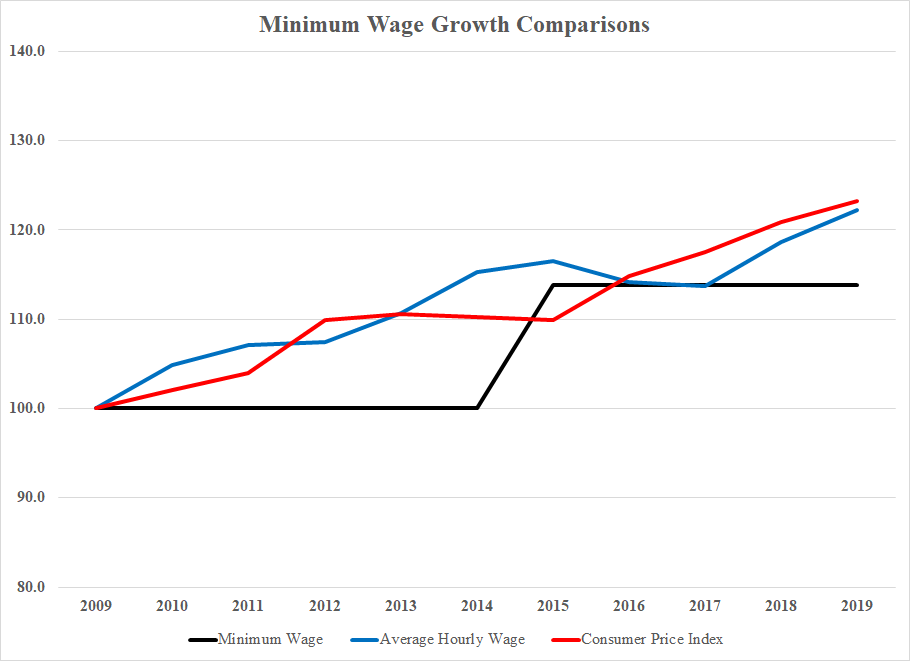
The comparison to the average hourly wage is presented here to bring in an evaluation of the efficiency of the minimum wage. In maintaining the efficiency of the minimum wage to its earlier standard, linking it to the earnings of the middle-wage worker would preserve parity between the returns to productivity accruing in the market to middle-wage workers to low-wage workers.
Absent evidence to the contrary, it is reasonable to expect that productivity rises similarly for low-wage workers as for middle-wage workers (presuming that the current cohorts remain comparable to prior cohorts, while the individuals will generally move from one cohort to another over time). A reasonable statistical stand-in for the middle-wage cohort would be the average hourly wage of production workers.
Keeping pace with the rising average hourly wage of production workers, the minimum wage would have been $8.85 in the first quarter of 2019.
As mentioned above, all else equal, raising the minimum wage to $9.25 per hour would be expected to lift some portion of low-wage workers out of poverty. In addition, the minimum wage increase more or less keeps pace with inflation, maintaining the purchasing power of the minimum wage compared to the previous standard of $7.25 per hour in 2009, and maintains overall competitiveness compared to the average hourly wage increases over the same period.
Increasing Employment Opportunities
One possible objection to the statement above would be that economic efficiency would be served by reducing the purchasing power of the minimum wage because it would increase employment opportunities among low-wage workers. Despite statements to this effect by some more conservative commentators, it is not well-supported by economic evidence, either in the United States or in Guam.
The contention by such commentators could be that if hourly wages are raised by raising the minimum wage, then higher unemployment rates and/or lower hours would be offered to low wage workers. This sounds plausible and worthy of serious examination. However, as documented in the Center for Economic and Policy Research’s “Why Does the Minimum Wage Have No Discernible Effect on Employment?”, the best research indicates that there is no statistical relationship between the level of the minimum wage and employment. Summing up the result of a meta analysis of the empirical data, Doucouliagos and Stanley are quoted thus, “Two scenarios are consistent with this empirical research record. First, minimum wages may simply have no effect on employment… Second, minimum-wage effects might exist, but they may be too difficult to detect and/or are very small.” That being the case, a moderate increase in the minimum wage (of a few dollars) would likely have a negligible effect on employment, thus providing real benefits to low wage workers.
In addition to the aforementioned research into the effect of minimum wages on employment in the United States, the government of Guam has relatively recently looked into the matter, itself. In January 2015, Guam’s minimum wage was raised from $7.25 to $8.25. In connection with that minimum wage increase, the Guam Department of Labor commissioned a study by Market Research and Development which was released in February 2017. The study found, ” no impact of the hourly minimum wage increase to $8.25 from indicators of Guam’s economy.” That result was based upon examination of the empirical data available. A Guam Business Survey was also included which states that only 11% of the businesses responding have reduced the number of employees. In fact, from December 2014 (just before the minimum increase) to December 2016 (the approximate time of the survey), the Current Employment Report data indicates that payroll employment increased by 1,320 or roughly 2.8%.
Given the background of empirical findings across the United States and the lack of evidence to the contrary for Guam, it is reasonable to conclude that modest increases in the minimum wage, such as the $1 which has recently been enacted, will have little to no adverse economic impact and will therefore result in an overall improvement of the standard of living to low-wage workers. This results in an overall minimum wage that is consistent with the stated policy of the “Minimum Wage and Hour Act of Guam.”
 Janssen Economics
Leave a comment